
SEO editing is information architecture. Copywriting is writing. Here’s why the two disciplines require completely different skills and what the 2026 search environment demands.
May 26, 2026 · 4 min read
The practice of “writing for SEO” operated on a flawed premise: produce text containing the right keywords, and search engines would reward you with rankings. That premise is functionally obsolete. The 2026 search environment runs on semantic entity recognition, zero-click answer extraction, and AI-powered retrieval-augmented generation (RAG) systems that parse structured information. Not word count.
The search mechanic has changed
Zero-click search is not an edge case. Research from SparkToro established that over 57% of Google searches end without a click to any website. That number grows each quarter as Google’s AI Overviews, featured snippets, and knowledge panels resolve queries before users reach a result. Perplexity, ChatGPT’s web retrieval, and similar AI engines compound this: they extract direct answers from indexed content and surface them without directing users to the source.
What determines which content gets extracted? Not keyword density.
Search engines in 2026 operate on entity graphs, interconnected webs of named concepts, their attributes, and their relationships. When Google’s systems parse a page about “SEO content editing,” they are not counting how many times that phrase appears. They are determining: is the entity “SEO Content Editor” fully defined, with clear attribute relationships, role, skills required, contrast entities, semantic neighbors? Is the answer machine-parsable without requiring a human to infer structure?
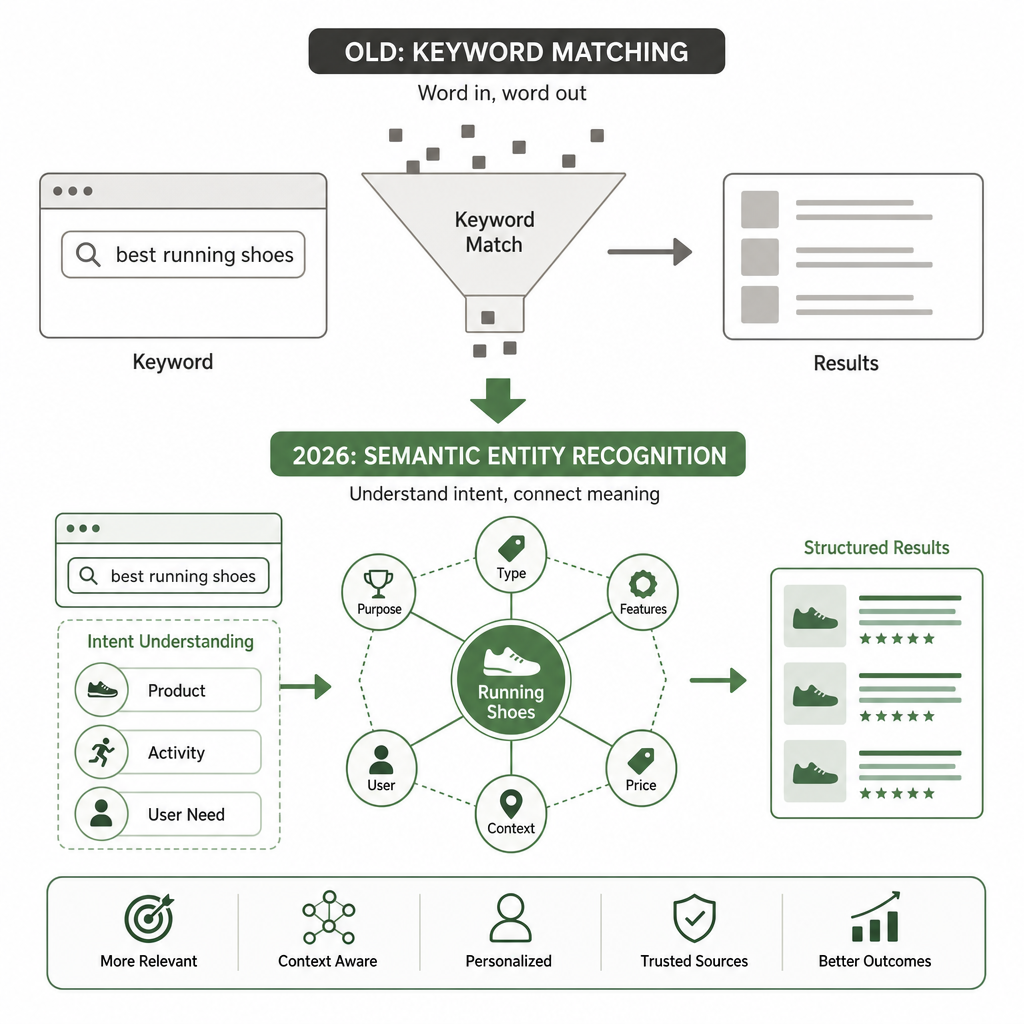
The implication is direct: satisfying search intent now requires structured data, not text density. A page that defines what an SEO content editor does in a single, semantically complete paragraph will outrank a 2,000-word article that never precisely defines its subject.
The differences between SEO editing and Copywriting make them different professions
Copywriting is the craft of creating persuasive text. Its goal is emotional resonance to move a reader toward a decision. It demands narrative instinct, brand voice fluency, and the ability to construct a compelling argument that converts.
SEO editing is categorically different. Its goal is information architecture: structuring content so that human intent and machine logic are simultaneously resolved. The SEO editor does not primarily ask “is this compelling?” They ask: is this entity fully defined? Is this query resolved at the H2 level? Does this answer pattern match what a retrieval system would extract and surface?
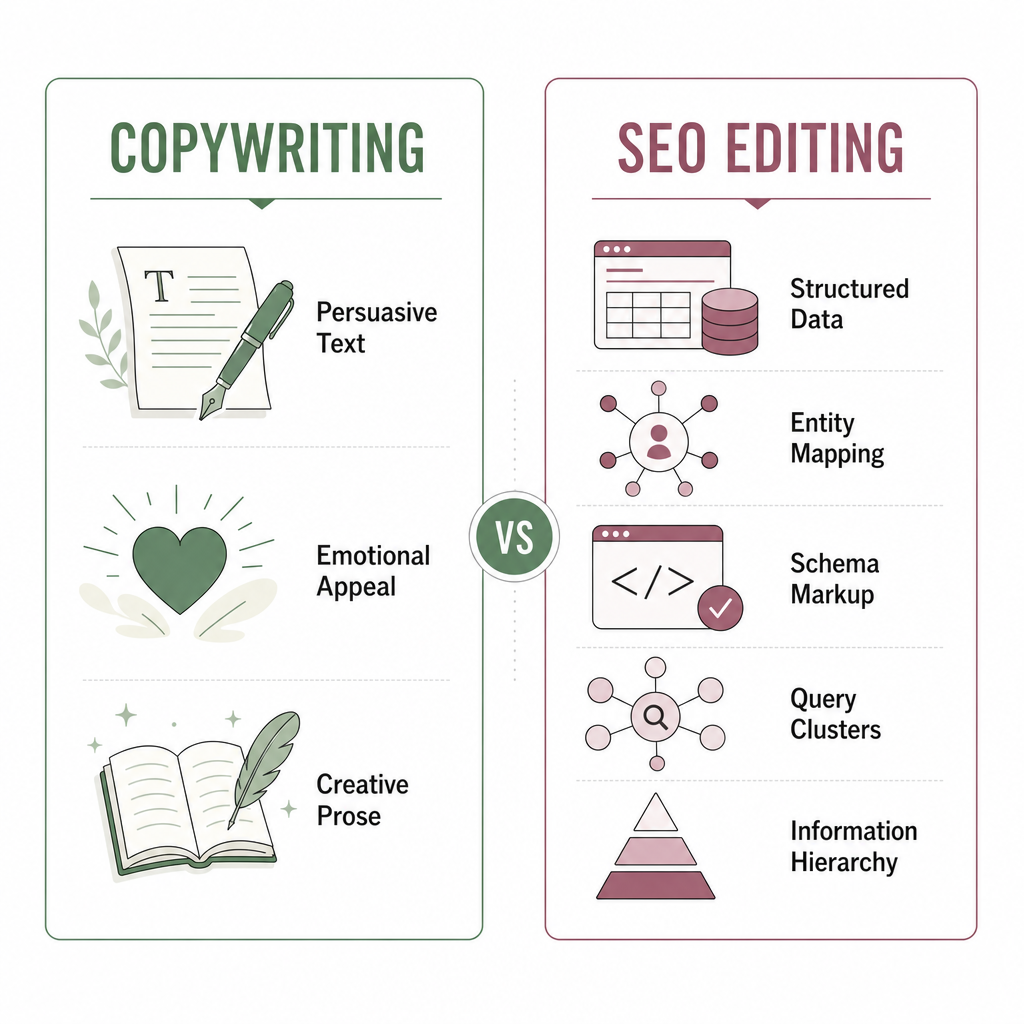
The skills do not overlap as much as the industry has assumed. A skilled copywriter may produce excellent text that ranks for nothing, because the semantic entity structure is absent. A skilled SEO editor may produce content that reads efficiently but dominates the SERP, because every query cluster is mapped and every entity relationship is explicit.
The industry requires professionals to stop hiring for one when they need the other.
Answer engine optimization write for retrieval, not reading
The emergence of AEO (Answer Engine Optimization) as a distinct discipline reflects a structural shift in how information surfaces. AI engines (Perplexity, ChatGPT, Claude, Gemini) do not read content as humans do. They parse it. They extract the most direct, semantically complete answer to a query and return it as a response.
Effective AEO strategy demands that each H2 section in a piece of content be a complete, self-contained answer to one specific query. The body text directly below the heading should resolve the question before elaborating. The entity named in the heading must match the entity a searcher would type or speak. No assumed context. No reader continuity required.
This is why information architecture supersedes rhetoric. A well-structured direct answer will be extracted and served by a retrieval system regardless of how the surrounding prose reads. A beautifully crafted narrative that buries its answer three sentences into a fourth paragraph will be ignored by the same system.
What the modern SEO editor must actually do
Effective strategies demand a technical skill set that has nothing to do with writing ability:
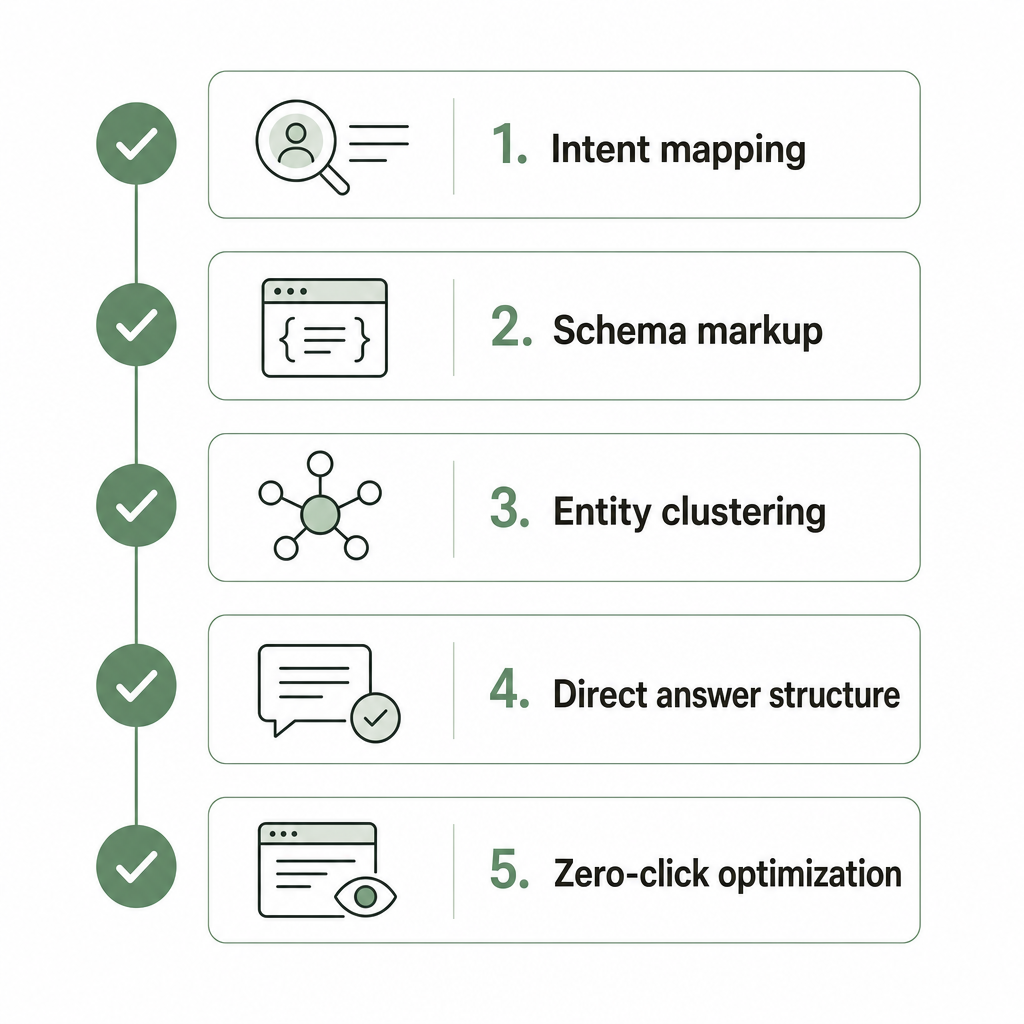
- Intent mapping: Classify each query served by a piece of content by type: informational, navigational, transactional, commercial investigation. Assign the appropriate content structure to each classification.
- Entity definition: Ensure the primary subject of each page is explicitly defined, with its key attributes, contrast entities, and semantic neighbors all addressed within the first 200 words.
- Schema implementation: Apply structured data markup (FAQ schema, HowTo schema, Article schema) so search engines can parse content type without inference. This changes what positions the content qualifies for.
- Query clustering: Group semantically related queries under single H2 sections rather than producing separate thin pages for near-identical intent. Clustering increases topical authority; fragmentation dilutes it.
- Zero-click optimization: Structure key definitions and answers so they qualify for featured snippets and AI Overviews, understanding that visibility without a click still builds entity recognition and brand authority.
Five shifts editors can make today
The gap between current practice and what 2026 search demands is not insurmountable. These five shifts change ranking outcomes without requiring a full content overhaul:
- Lead with the direct answer. The first sentence under any H2 should resolve the query in that heading without requiring the reader to continue reading.
- Define your subject entity explicitly. Never assume the reader or the search engine knows what your primary subject is. Name it, define it, contrast it with adjacent entities in the first 200 words.
- Replace keyword repetition with semantic coverage. Identify the 5-7 semantically related entities that must appear on any complete page about the subject. If they are absent, the entity map is incomplete regardless of keyword density.
- Mark up what you have already written. FAQ schema, HowTo markup, and Article schema require no content changes. They require implementation. The information is already there; the structure is not declared for machines.
- Audit for query gaps, not word count. The diagnostic question is not “is this long enough?” but “does this content resolve every query a searcher might have at this stage of intent?”
SEOL Digital
Applying these principles to your content requires both the methodology and the execution. SEOL Digital specializes in exactly this work. Translating expertise into structured, search-optimized content that makes professionals visible to the right audience. Whether that means restructuring existing pages for semantic clarity, writing 1,000-word authority articles built on entity mapping, or auditing site architecture for query coverage, the approach is SEO editing methodology. Not copywriting instinct.
Frequently Asked Questions
How does semantic relevance override keyword density in 2026?
Search engines now use entity recognition to understand content meaning rather than keyword frequency. A page that fully defines its subject entity, addresses its key attributes, and covers semantic neighbors scores for topical authority regardless of exact-match repetition. Keyword density is not a ranking signal; semantic completeness is. SEOL Digital structures content around entity maps, not keyword counts.
What role does structured data play in content visibility?
Structured data tells search engines explicitly what a piece of content is and what it answers, without requiring machine inference. Applying FAQ schema, HowTo markup, or Article schema increases the probability that a page surfaces in featured snippets, AI Overviews, and knowledge panels. All zero-click answer positions. Without it, the information may be correct but invisible to automated extraction systems.
Why is information architecture superior to keyword stuffing?
Keyword stuffing targets one query signal: exact-match text. Information architecture targets the full retrieval process: entity definition, semantic relationships, direct answer structure, and schema markup. A well-architected page satisfies AI engines, featured snippet algorithms, and human readers simultaneously. A keyword-stuffed page satisfies none of them in 2026, and risks a manual penalty for the attempt.
How do modern SEO editors bridge user intent and machine discovery?
They work in two layers simultaneously. At the human layer, they map query intent (informational, commercial, transactional) and structure content to resolve it at the appropriate depth. At the machine layer, they ensure entity definitions are explicit, answers are positioned directly under the relevant heading, and schema markup is applied so retrieval systems can extract content without inference. The gap between the two layers is where most content fails.
What skills do SEO editors need that copywriters do not?
SEO editors need technical skills outside the copywriter’s remit: entity mapping, schema markup implementation, query clustering, zero-click positioning, and familiarity with how AI retrieval systems parse and serve content. These are architectural decisions, not writing decisions. A copywriter who cannot think in information structures is not an SEO editor regardless of how well they write.